On pigs and censorship, a declaration of intent
“It's despite this destructive impetus that the selection of ideas pays off and the internet can be the best outcome.”

Svalbard Global Seed Vault.
When we think about evolution and about how genes replicate themselves it's hard not to associate it only with chemistry and biology, but genes are basically information, therefore, evolution is a process which selects the best codes or sets of information. From this it´s possible to find other flows of information present in our daily lives that we usually don't see under evolutionary lights. This other category of information refers to the ideas itself or memes, term created by Richard Dawkins. Here the definition of memes includes but doesn't restrict itself to what the internet understands by meme: viral texts and images. The meme is the smallest functional part of an idea and could, in a rough manner, be considered it's gene.
To cook wasn't always common, hundreds of thousands of years ago a work of genius was to discover that, for example, a pig could be food and probably would be much tastier after cooking. According to the primatologist Richard Wrangham, cooking allowed us, by improving our digestion, to develop our brains to the point they exist today. This meme still exists and was selected for being well adapted and although in this specific case it's a beneficial meme it doesn't mean that any well adapted meme is good for us. History shows us that memes related to slavery, misogyny and racism are also very resilient and hard to be abandoned
Before the invention of writing we had to rely on oral tradition and visual methods like drawings, dances and representations through clothes and masks to preserve and propagate memes. Some memes don't last, others, like the meme of cooking, can last for a long time and just as similar genes can exist in different species also a meme can perpetuate itself on a variety of forms, be it paintings, music, poem or even architecture.
On the other hand ideas are active (or alive, if you prefer) only while handled by the human mind, like the living beings, they depend on the environment to propagate. These memes get popular not because they're “good” or “bad” but due to their level of adaptation and their environment is the mind and the society of each human being that's dealing with them.
It's easy to identify ideas that behave like diseases. Homophobia, for example, is a prejudice whose memes are being fought in Brazil creating the need to disseminate other memes that refute and deconstruct this source of stupidity. This process isn't simple nor fast and nothing can grant that it will last.
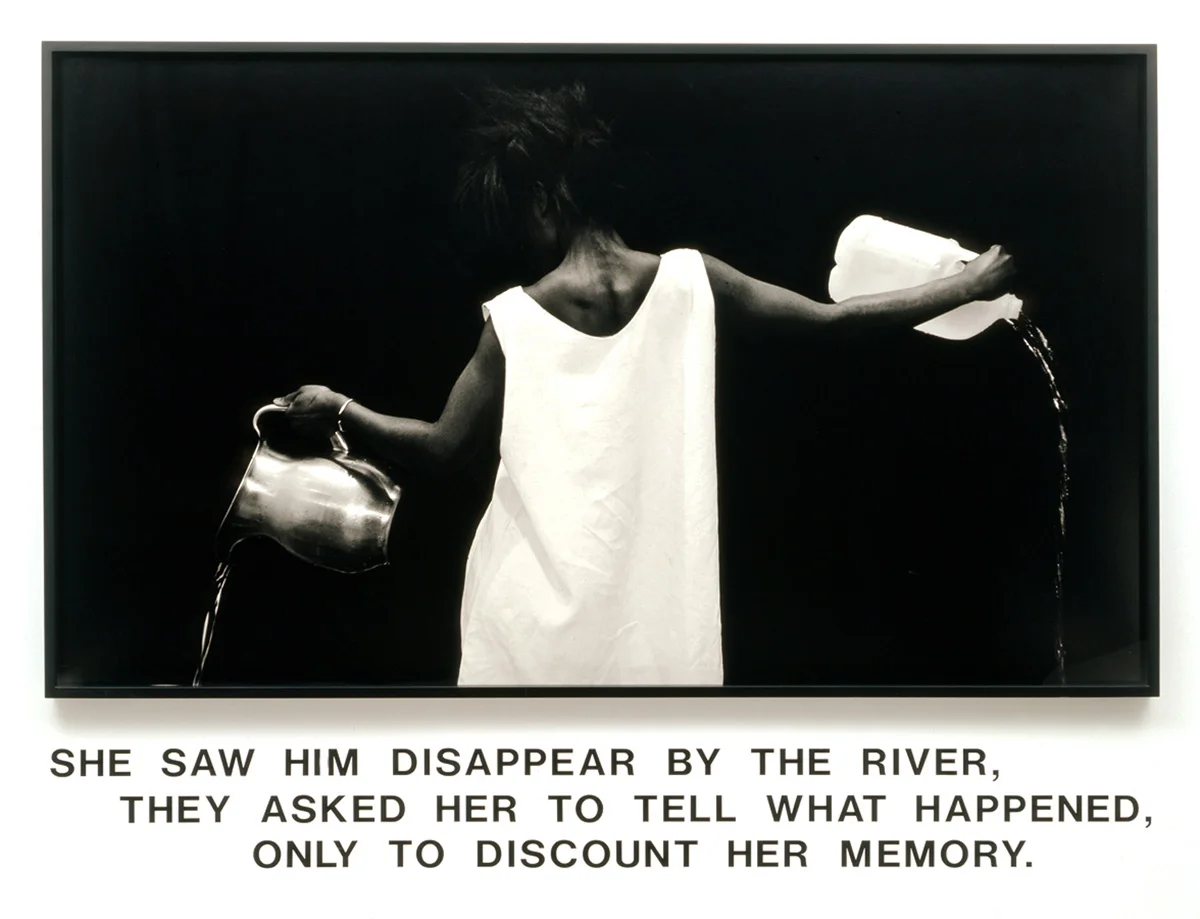
Waterbearer. Lorna Simpson, 1986.
The fight against racism began a long time ago and from a historic perspective there's some changes, although far from any passable level. These changes happened because the memes that supported the most radical forms of this prejudice are less present in our society now. It only happens due to a conjunctural transformation that goes beyond the existence of theorys and ideas that tackle the problem. To create the right memes and systems of repudiation isn't enough because they must be shared and replicated by the majority of the society to be effective.
Libraries, museums and cinematheques preserve and expose memes that sometimes were circunscribed to their time, region or culture and can't find space to perpetuate themselves, like happens with works of ancient societies and religions or with the art produced by minorities. Museums are gathering so many people because this diversity of memes shows us a broader concept of humanity. The technical hability matter less because in a museum it's the perception of our own fears and aspirations depicted in works of people we regard as “they” that generates empathy. Sadly the term “they” doesn't include only extinct societies, usually it's about our contemporaries also and this is the reason why these institutions must be open to what's being created today. To perceive that “they” are like “us” is one of the greatest feats of art. This understanding arises not only from the exposed pieces. The collection being cured by the institution benefits from the predisposition to empathy from the visitors to create an environment that would hardly be possible outside these plural spaces.
The aim of preserving and sharing not only old memes but also this less obvious sense of empathy is achieved both by the physical space and the subjective existence of these institutions. At museums it's not hard to find less important pieces, sometimes almost irrecognizable fragments of ancient civilizations that would pass unnoticed anywhere else, having lines of people to see, even with certain reverence, a degraded piece of clay. We visit musems with a good will towards the exposed pieces and their creators, being disposed to appreciate their culture, to understand them and see their mistakes and atrocities not as something that devalues them but as important lessons.
It's this feeling of human congregation and reverence for art that any form of censorship, be it for moralist or political interests or in the name of some divinity, struggle to destroy and when it comes to memes it isn't the same as banishment or disuse. Few societies today even tolerate a serious discussion about slavery because this meme is out of circulation as a achievable idea and simply isn't accepted. However, Aristotle advocates in favor of slavery at his “Politics” and we still study his books instead of destroying them or censoring these parts. Freedom includes responbilities like knowing how to deal with informations and how to ensure that our descendents will not be penalized by our acts. Obligations that cover the constant caution with bad memes but also the preservation of their history. We would be poorer without this knowledge, the suffering that ideas like this have caused is a lesson which we can't forget without accepting the risk of having to learn it all over again, maybe with greater hardships.
That's why we don't erase the holocaust from history and that's why we have holidays like the black awareness day. It's hard to understand a holiday as something important, specially when the fight has changed without being updated at the colective social mentality as occurs, for example, with feminism at International Woman's Day. Having a day like this is to grant that at least once a year this debate will not be ignored. Holidays are a colective tool of exposition and rescue of memes, reason why we should give more attention to the meaning instead of the free time they allow.
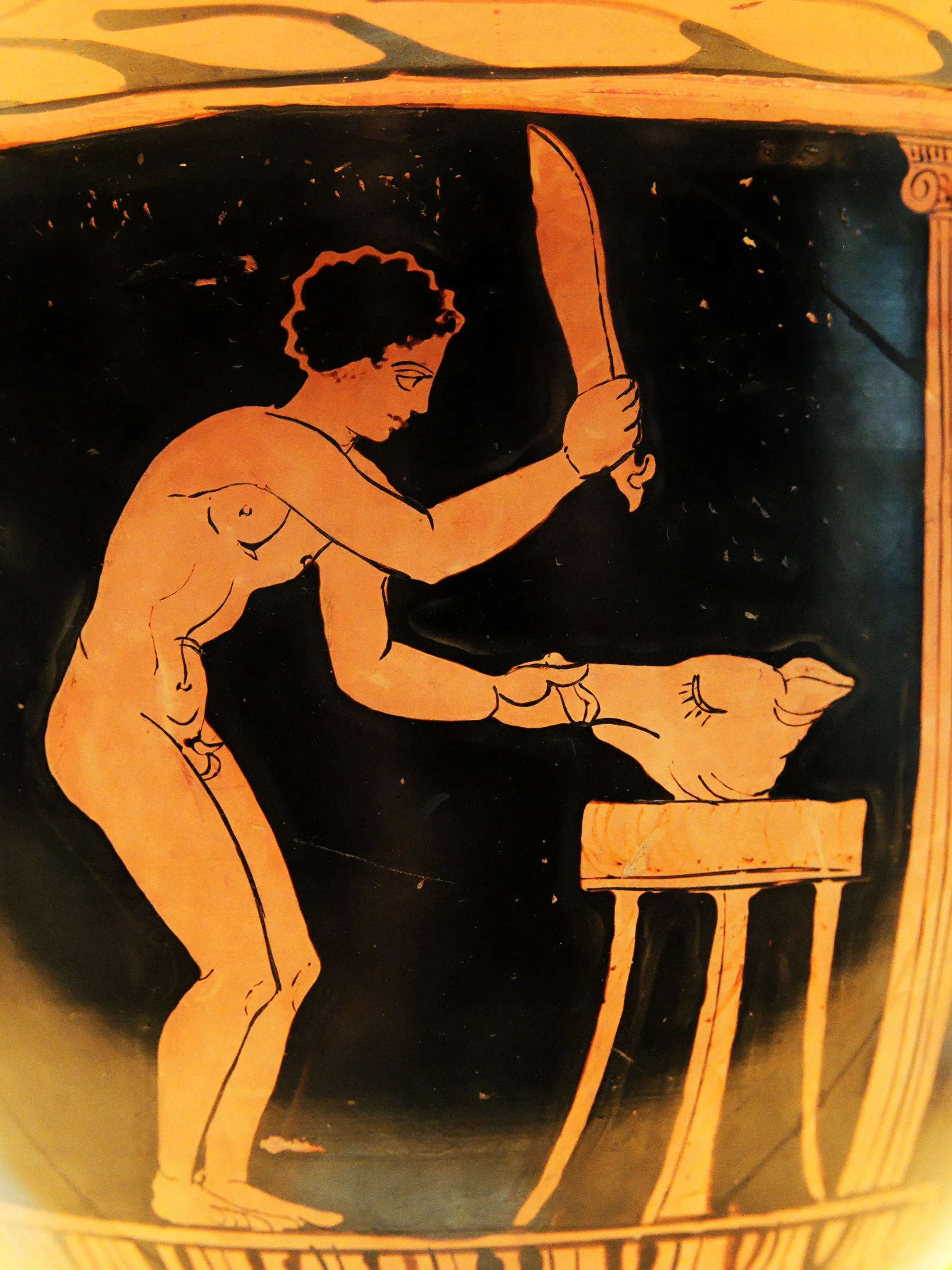
Young man preparing a pig's head after sacrifice. Vase.
The disrespect to freedom of speech and the religious radicalism aren't new, groups like ISIS exist to prove that we will not be free of this threat anytime soon. At Brazil the operations of the Military Police during the protests showed beyond their usual unpreparedness also a disrespect towards the political expression. Those groups don't enrich the debate, their violent actions are the own denial of the dialog, they're anti-meme agents. It could have been catastrophic if in the past some kind of police force repressed cooking because they felt empathy for the other pigs or simply desired to maintain the conservative custom of eating raw meat. Happily the means to avoid the repressive constraints were always one step ahead. It's despite this destructive impetus that the selection of ideas pays off and the internet can be the best outcome.
On the digital media the information isn't at such a precarious situation like what happens to single manuscripts of ancient epics carried by the minds of elders. The wild destruction and the censorship are still no match to the internet. The least we can do is to occupy this space to digitize all the memes we can, not because to read a e-book or to appreciate a 3D render of a sculpture are better than the originals, but because this is a way to preserve and share memes and a method to undermine the censor using his own ignorance. While online ideas mate and collide with the same importance that death and sexual reproduction have to living beings, ideas are breed on the internet. Here gods bleed and authorities fail and it's up to us to realize this subversive potential.

Bottles in the sea: online communication and the receiver with a thousand faces
“...but if we want the potential benefits to become real it's essential that we focus on less funny things and make efforts towards greater complexities and new contacts with unknown ideas.”
It's common to discover a new hobby or unusual subjects and when we search for them on the internet we soon discover many pages and communities dedicated to them. Despite being small sometimes they're composed by people from many countries sharing the same interest. Specialized fóruns can be disorganized but they also have a surpring amount of information coming from people who share their knowledge for free, sometimes inadvertently, giving the internet it's fame of having all kinds of informations at a very low cost, if any.
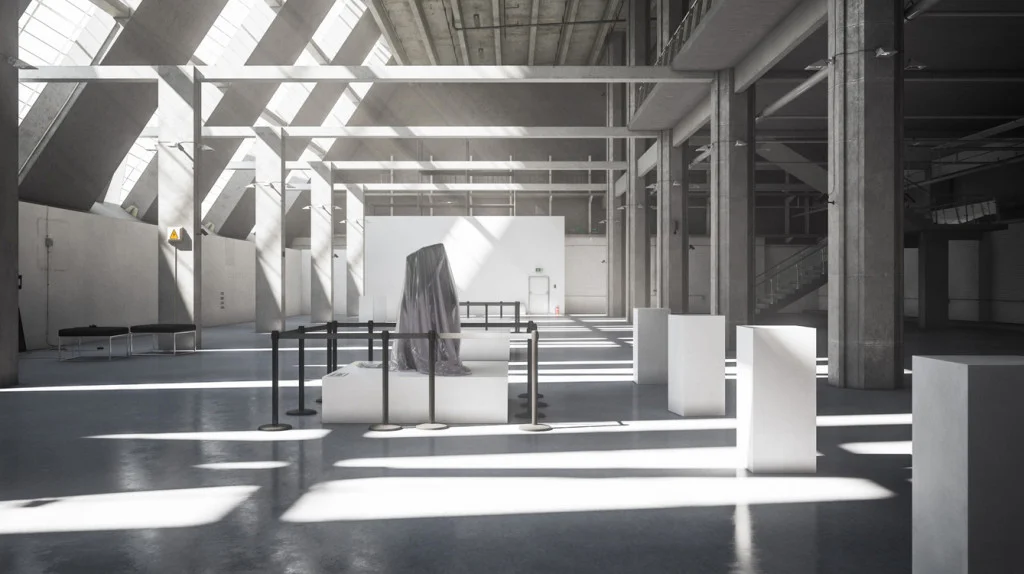
Panther Modern. Digital art gallery by LaTurbo Avedon. (Click to see)
As sealed bottles with messages floating in the sea waiting for the casual meeting when the comunication will finally abandon it's mere pontential state, being on the internet doesn't mean it'll be accessed since there's always barriers like search engines, content agregators and the market tactics used by social media to enforce payment if the creator wants to reach his audience. Even though these do not deny the access they can strongly restrict the contact with a wider public. It's excessively optimistic to say that everything can be found on the internet, but the internet at least touches everything. Here we reproduce our connections from outside of it, therefore there's the possibility for any content, even if it depends on other aspects to leverage it's relevance.
To realize this idea of the internet free content is, by chance, to see that which is trivial or familiar to you being the unexpected and rare for others. To share your own experience and knowledge publicly, even in a limited medium to this kind of interaction, already is a way of making things more accessible. Specially because it's not necessarily a copy of something to the internet, but a true reelaboration of this subject and, therefore, dependent on who is doing it. This reformulation must ensure that the final result will be comprehensible for most people, even those who don't have the tools to reach it by themselves, making it better to lose something in translation than to allow the worries with the details block the possible dialog.
Umberto Eco considered his unread books an essential part of his personal library – containing 30 thousand books – because they were a potential research material and a clear reminder of how much he still had to learn. The posts seen but not read and the critics of books the reader may not know, as can happen here, also allow this curiosity that far from replacing the original work and profound studies, works as a intermediary for those who don't want or don't have the oportunity to reach these works and books. For those who read it's always a challenge and a invitation to devote some thoughts to it again.
With the virtual realities came the supposition that someday we'll abandon this real life as we know it, but the digital and the internet are extensions as real as the “analog” version of our existence and cannot be separated from our other life experiencies, which we still mistake to understand while insisting in considering it as something much different from our online existence. This care doesn't exclude the entertainment and the lightness common to our online interactions, but if we want the potential benefits to become real it's essential that we focus on less funny things and make efforts towards greater complexities and new contacts with unknown ideas, even if it generates that feeling of discomfort, even if it means to put aside the Facebook.
It's hard because we already do it in our daily lives, we deprive ourselves of so much in our efforts around our obligations and expectations both personal and professional that the internet appears as a relaxing tool after these harsh goals. But we also do this even despite the obligation, we spend money and time on books, parties, art, movies, theater and music and the benefits aren't tangible as in other materialistic situations. There's no clear exchange besides the experience and the contact with the work of others. Still, we keep doing it because living is also to assume that things like personal analysis, philosophy, interior reflections and imersion in art and other people's minds with the same fears, anxieties and joys are more urgent than the cheap mindless entertainment, our jobs and hedonistic pleasures, and this is the reflection we need to develop to fully enjoy our own potential with the internet.
As content creators – and in apps like Snapchat, Instagram and Facebook we all are creators – the seduction, the tempting invitation to meet new ideas, as religions and political parties knows and teaches us very well, this invitation must seduce, convince, persuade the other to take a look at our ideas. That's the function of beauty, music, design, simple dialog, sense of community and the gratuity, be it apparent or not, in these institutions. But if their methods works then we aren't talking about condemning religions and politics because they're so good at convincing people and ploriferating their ideas. The important is that people with better proposals should pay more attention to these details, specially because many of them deem it to be vulgar or superfluous, because disarming the other and making them listen is as important as having something valuable to say.
Alain de Botton held a presentation on the Rijksmuseum exhibition Art Is Therapy.
Due to the constant dispute for our attention we end up bombarded without mercy, from Whatsapp to Instagram, cat videos, breaking news, memes, events, messages, everything fighting for our focus and this environment by itself make it harder for any attempt of a serious personal enhacement. In this virtual reality rises a service that we already know to be essential in our lives, that of the curator. Museums, galleries, literary fairs, libraries and even movie theathers, all of them act as curators, despite not always providing what we need, they allow us to navigate a complex body of work and thought while freeing us from the efforts of the specialist and the critic. Wikipedia, Google and Youtube are indeed important, but the curator can show us what we should be searching there and also convince us to give this step towards personal and intelectual knowledge.
I write from this position, as a writer and also a curator of the few things I have to share, but that I must share. From the responsiblity of giving back the learning oportunities I had, and still have, to benefit others, but also conscious of the hardships involved in sending a message to someone, hardships that I know well since they're also mine. The Pantagruelista is back with the same objective, a trustworthy and well curated content about philosophy, literature and art and the introduction of ideas capable of interrupting our mental homeostasis and this time with renewed energy to create this fertile state of cognitive entropy.