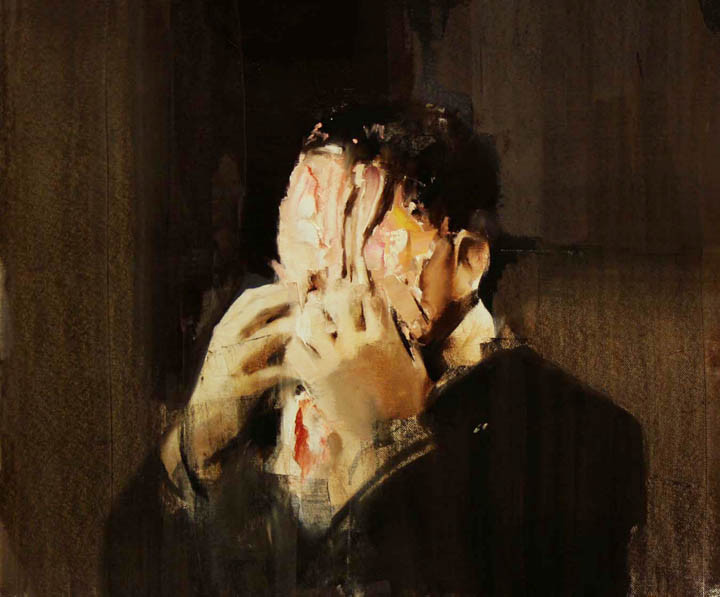
Modern literature and the death of the Author in Roland Barthes
“...literature is that neuter, that composite, that oblique into which every subject escapes, the trap where all identity is lost...” - Roland Barthes
It's common to see fans seeking explanations about movies and books on the authors, considering them the only reliable source of interpretation, but Anne-Marie Willis argues that the designer has no prevalence over his creation. And there's a great thinker foccused on literature who followed a somewhat similar line of thought. In 1968 Roland Barthes published “The death of the Author”, a instigating text about the relation of the Author, the Critics and of the Reader with the modern literature.
If both of them converge to a critic that undermines the importance of the creator, Barthes was more interested with literature and went beyond, showing that to question the image of the Author is also questioning the Critics. Barthes asserts that literature is independent, a body of symbols:
“All writing is itself this special voice, consisting of several indiscernible voices, and that literature is precisely the invention of this voice, to which we cannot assign a specific origin: literature is that neuter, that composite, that oblique into which every subject escapes, the trap where all identity is lost, beginning with the very identity of the body that writes.
Probably this has always been the case: once an action is recounted, for intransitive ends, and no longer in order to act directly upon reality — that is, finally external to any function but the very exercise of the symbol — this disjunction occurs, the voice loses its origin, the author enters his own death, writing begins.”
Stéphane Mallarmé was a french critic and poet to whom Barthes credits the pioneering in this concept of literature:
“In France, Mallarme was doubtless the first to see and foresee in its full extent the necessity of substituting language itself for the man who hitherto was supposed to own it; for Mallarme, as for us, it is language which speaks, not the author: to write is to reach, through a preexisting impersonality — never to be confused with the castrating objectivity of the realistic novelist — that point where language alone acts, “performs,” and not “oneself”: Mallarme’s entire poetics consists in suppressing the author for the sake of the writing (which is, as we shall see, to restore the status of the reader.)”
Against the conventional critic and questioning not only the place of the author but even the literary canon, Barthes goes on with the idea that a work is always dependent on the reader:
“The Author is supposed to feed the book — that is, he pre-exists it, thinks, suffers, lives for it; he maintains with his work the same relation of antecedence a father maintains with his child. Quite the contrary, the modern writer (scriptor) is born simultaneously with his text; he is in no way supplied with a being which precedes or transcends his writing, he is in no way the subject of which his book is the predicate; there is no other time than that of the utterance, and every text is eternally written here and now.
[...]
We know that a text does not consist of a line of words, releasing a single “theological” meaning (the “message” of the Author-God), but is a space of many dimensions, in which are wedded and contested various kinds of writing, no one of which is original: the text is a tissue of citations, resulting from the thousand sources of culture.”
Opposing the image of the Author and that of the writer, he exposes what he consider to be a multiple writing:
"Succeeding the Author, the writer no longer contains within himself passions, humors, sentiments, impressions, but that enormous dictionary, from which he derives a writing which can know no end or halt: life can only imitate the book, and the book itself is only a tissue of signs, a lost, infinitely remote imitation.
[…]
In a multiple writing, indeed, everything is to be distinguished, but nothing deciphered; structure can be followed, “threaded” (like a stocking that has run) in all its recurrences and all its stages, but there is no underlying ground; the space of the writing is to be traversed, not penetrated: writing ceaselessly posits meaning but always in order to evaporate it: it proceeds to a systematic exemption of meaning. Thus literature (it would be better, henceforth, to say writing), by refusing to assign to the text (and to the world as text) a “secret:’ that is, an ultimate meaning, liberates an activity which we might call counter-theological, properly revolutionary, for to refuse to arrest meaning is finally to refuse God and his hypostases, reason, science, the law."
Barthes calls out the negligence with the figure of the reader and contests the idea that it depends on the Author:
"In this way is revealed the whole being of writing: a text consists of multiple writings, issuing from several cultures and entering into dialogue with each other, into parody, into contestation; but there is one place where this multiplicity is collected, united, and this place is not the author, as we have hitherto said it was, but the reader: the reader is the very space in which are inscribed, without any being lost, all the citations a writing consists of; the unity of a text is not in its origin, it is in its destination; but this destination can no longer be personal: the reader is a man without history, without biography, without psychology; he is only that someone who holds gathered into a single field all the paths of which the text is constituted.
[…]
We know that to restore to writing its future, we must reverse its myth: the birth of the reader must be ransomed by the death of the Author."
Subversive, “The death of the Author” is the kind of idea that still needs to be debated. And maybe this is the definition of any relevant thought. In 1968 Barthes made an objection that no reader nor writer should ignore, but that's still less popular than it should, at least out of the academic circles.
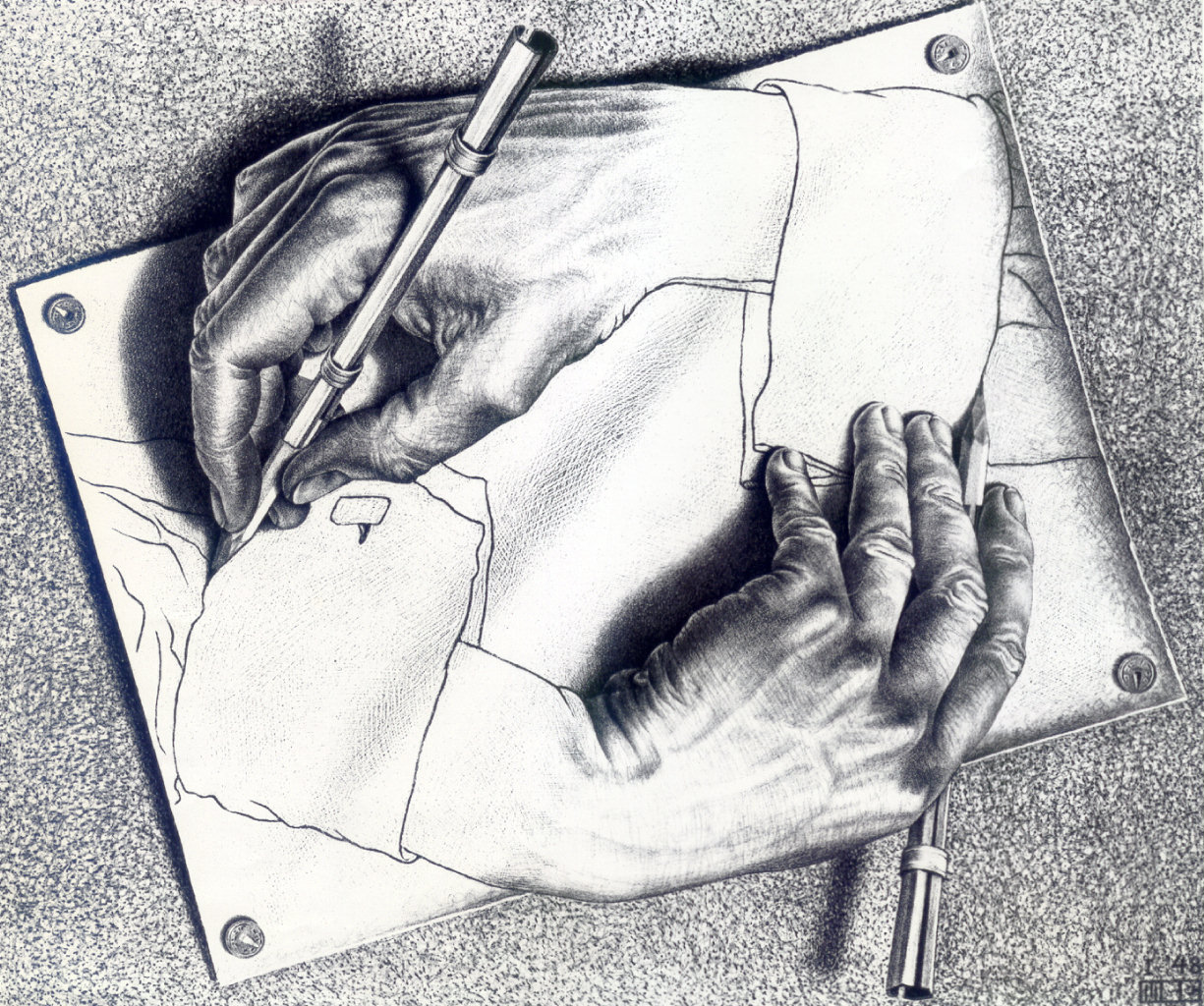
Being and Design: Anne-Marie Willis on the hermeneutics of our creations
"‘Design designs’ also includes the designing effects of that which designers design."- Anne-Marie Willis
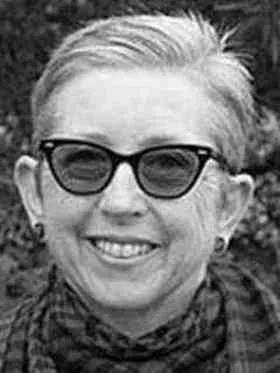
Anne Marie-Willis
With the development of virtual reality technologies the world is opening itself to new creative possibilities beyond the idea of a virtual environment where access is mediated by computers and gadgets, because now we can go inside these environments as much as we can connect and simulate an alternative reality. However, what's the effects of living, even temporarily, in these artificial worlds? More important, what's the artificial? And how new technologies can affect us? There's already a lot of thinkers working on those questions but here I'm going to introduce an important area that has a broader approach on design, the Ontological Design.
The article “Ontological designing – laying the ground” published at the Design Philosophy Papers on June of 2006 gives us an idea of what's this line of thought. Written by Anne-Marie Willis —— who has many published books and scientific articles that range from visual culture and architecture to design and cultural theory – the article is basically an introduction to the concept.
Willis begins by explaining what's she talking about when she says Ontological Designing:
“To begin simply, ontological designing is a way of characterising the relation between human beings and lifeworlds.”
But she isn't meaning only that “we are conditioned by our environment’ or ‘we are shaped by the cultures into which we are born”, because:
“Ontological designing, then, is (i) a hermeneutics of design concerned with the nature and of the agency of design… (ii) an argument for particular ways of going about design activity, especially in the contemporary context of unsustainability.”
As a theory, she writes, the Ontological Design postulates:
“That design is something far more pervasive and profound than is generally recognized by designers, cultural theorists, philosophers or lay persons
That designing is fundamental to being human – we design, that is to say, we deliberate, plan and scheme in ways which prefigure our actions and makings – in turn we are designed by our designing and by that which we have designed (i.e., through our interactions with the structural and material specificities of our environments);
That this adds up to a double movement – we design our world, while our world acts back on us and designs us ”
She explains this double movement using the example of language in a proccess by which we understand the whole by it's parts and the parts by the whole, therefore, a hermeneutic circle:
“It is useful to think of the hermeneutic circle in three moves, taking the example of language. While we cannot think outside of language, this does not mean we are totally programmed: (i) we are born into and come to be human in language; (ii) we appropriate it, modify it, perhaps put words together in ways that they have not been combined before, encounter new situations which require new words; (iii) thus in appropriating language we also change it, and language-as-changed in turn acts back on us as language users.”
The hermeneutic circle implies a designing both of the being and of that which was designed. Willis also indicates regions where it can occur:
“Ontological designing as a condition of being could be seen as inhabiting three continuous inter-connected regions: 1. as it applies to conventionally considered designed things — e.g., buildings, manufactured objects 2. extending on from this there is the ontological designing of material and immaterial infrastructure, of e.g. management systems, of information technologies, of communication systems, and then there is, 3. the ontological designing of systems of thought, of habits of mind.”
To Willis the most clear examples of Ontological Design are connected to equipments and technology and the study must associate both the material and the imaterial aspects of the design:
“However, this carries risks, particularly once the material character of equipment is left behind to consider the ontological designing of the non-material, for example, of systems of organisation or methods of thinking… The risk is a loss of specificity in which ontological designing could be seen as equivalent to ‘environmental determinism’, carrying no more agency than ‘influence’… Yet to make a material/non-material distinction for ontological designing is partly to miss the point — because in most situations both are present — thus the designing effects of an administrative system are inseparable from its materialised environment of IT infrastructure, forms, filing cabinets, work stations and work hierarchies, flows of paperwork and electronic information.”
Maybe the key point of her paper, Willis discuss the relevance of the designer and of the stages of the hermeneutic circle:
“‘Design designs’ also includes the designing effects of that which designers design (objects, spaces, systems, infrastructures). The significant point here is that all these designings are of the same order. That is, no distinction is being made about the nature or relative significance of determinations; neither object, process nor agent is granted primacy. Traditionally agency has been posited with the designer — the assumption being that the designer’s intentions are embedded within the designed object which then causes the object’s user to do things in certain ways. But the problem here is a flawed model of causality based on a linear temporality, in which it is assumed things can be traced back to origins further back in time — there is no particular need for this assumption when attempting to explain phenomenologically the designing that is going on in a particular situation. The fact that teams of designers worked on the configuration of the screen and keyboard I am now using cannot really help me to understand that my using this equipment is at the same time this equipment designing what I am doing. Once the comfortable fiction of an originary human agent evaporates, the inscriptive power of the designed is revealed and stands naked.”
In the article it's also possible to understand how Anne-Marie Willis bases her work on Heidegger, especially when it comes to the hermeneutic circle. This is an essential reading in this moment of changes in the virtual and physical spaces, changes that can affect us much more than may seem at a first glance. The power of such broad changes can also be seen in the critic article of James Joyce about the Renaissance.
Complement this reading with a mind bending vídeo by Jason Silva on the subject of Ontological Design:

Renaissance and the birth of the modern man, according to James Joyce
“Indeed, one might say of modern man that he has an epidermis rather than a soul.” - James Joyce
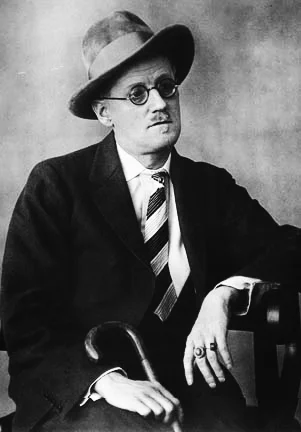
James Joyce is known and imortalized due to his works of fiction, specially for Ulysses, a book so debated it's said that people talk about it more than they read it. Beyond fiction Joyce was an critic and essayist. In his wanderings over the world he wrote in many languages.
On april of 1912, two years before officially publishing his first title, Dubliners, Joyce wrote “The universal literary influence of the Renaissance”. This essay, originally written in italian, show his sharp and somewhat conservative view on what was the Renaissance and how it's influence extends to the modern man.
Joyce begins by questioning the idea that humanity only achieved maturiy after the Renaissance:
“I agree that this social system can boast of great mechanical conquests, of great and beneficial discoveries ... But in the midst of this complex and many-sized civilization the human mind, almost terrorized by material greatness, becomes lost, denies itself and grows weaker.”

Movie "Modern Times", 1936.
This change, according to a almost nostalgic Joyce, happened as a rebellion against the scholastic absolutism and against the aristotelic philosophical system which had the christian religion as it's peak. In this rebellion:
“[The human spirit] abandoned it's peace, it's true abode because it had tired of it, just as God, tired (if you will permit a rather irreverent term) of his perfections, called forth the creation out of nothing, just as woman, tired of the peace and quiet that were wasting away her heart, turned her gaze towards the life of temptation.”

Shakespeare. A Joyce's favorite.
However, Joyce never cease to aknowledge the value of the literary production of that time:
“It would be easy to fill these pages with the names of the great writers who the wave of the Renaissance lifted to the clouds (or thereabouts), easy to praise the greatness of their works which, in any case, no one is calling into doubt, and to end with a ritual prayer: and it might be an act of cowardice since reciting a litany is not philosophical inquiry. The crux of the question lies elsewhere.”
Dismissing the easy way out he develops the core of his arguments. The crucial changing of the period was a changing of the mind that “placed the journalist in the monk's chair”:
“[the renaissance] has deposed a sharp, limited and formal mind in order to hand the sceptre over to a mentality that is facile and wide-ranging... a mentality that is restless and somewhat amorphous.”
The same power and impetus that left behind the formalism also had important effects over the modern mentality and the extrems it would reach:
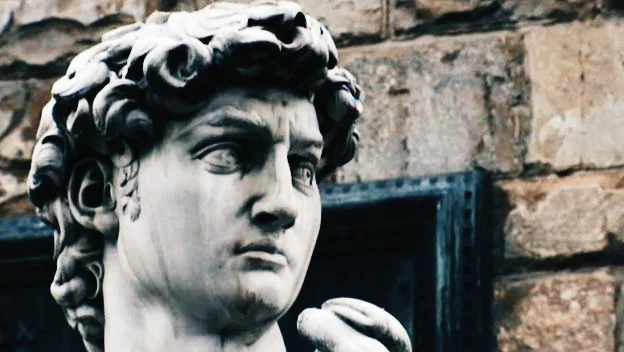
Michelangelo's David.
“Untiring creative power, heated, strong passion, the intense desire to feel, unfettered and prolix curiosity have, after three centuries, degenerated into frenetic sensationalism. Indeed, one might say of modern man that he has an epidermis rather than a soul.”
With a mixture of pessimism and comprehension Joyce moves foward evaluating the origin of the Renaissance and the final results of it's existence:
“Renaissance came about when art was dying of formal perfection, and thought was losing itself in vain subtleties.
[...]
The Renaissance arrived like a hurricane in the midst of all this stagnation, and throughout Europe a tumult of voices arose, and, although the singer no longer exist, their works may be heard just as the shells of the sea in which, if we put them up to our ear, we can hear the voice of sea reverberating.
Listening to it, it sounds like a lament: or at least, so our spirit interprets it. Strange indeed! All modern conquest, of the air, the land, the sea, disease, ignorance, melts, so to speak, in the crucible of the mind and is transformed into a little drop of water, into a tear. If the Renaissance did nothing else, it did much in creating whithin ourselves and our art a sense of pity for every being that lives and hopes and dies and deludes itself. In this at least we excel the ancients: in this the popular journalist is greater than the theologian.
James Joyce”
It's impossible to ignore the body of work that James Joyce left to us assuming his role, being a modern man, as a descendant of the phenomenon he diagnosticated. “The universal literary influence of the Renaissance” is an intelligent essay that has both feet on the ground all the time. It's a must read for any fan or academic interested on his works because it also reflects the mind of the writer.

I was face to face with the Abaporu and I barely looked at it
“And what can I do with it if in the room there’s a line to take selfies with the painting, if there’s a bulletproof glass between me and the painting and the lights of the gallery prevents me from seeing the canvas?”
Since a small child I learned in school to recognize and value Tarsila do Amaral’s paintings, but they never put me closer to it, I never got closer to it’s huge idealistic pedestal, I wasn’t even told that I could do it. I speak like that because I know that my formative experience is common to most student who some (if any) contact with arts classes in their earlier years
And at August 2nd I got myself face to face with two of her most iconic paintings, Anthropophaghy and Abaporu. It would be dishonest on my behalf if I acted like my academic formation and my artistic interests kept me in the same childish level of innocence/ignorance after all these years. When I got the exposition “The color of Brazil” at the Arte museum of Rio (MAR), it’s wasn’t as a layman, much less as a someone who causally deals with art. I went there very interested in studying the involvement of the visitor and the experience museums proportionate to the public.
With Rio de Janeiro about to host the Olympic Games and the city full of tourists, there in the museum I found the same crowd filled with energy, joy and curiosity. Still, few of them were there due to the exposition opening that day with great brazilian artists displayed, many people walked around these works like they were the same as the others, which do not desserve less attention, but this absence of mind or indifference were na extension of environment. Located in the Mauá Square, now part of the Olympic Boulevard, the public divided itself between the MAR and Museum of Tomorrow in huge lines, maybe without knowing exactly what to expect from these institutions beyond the photos they were about to make with the artworks and the exotic architecture of both the museums.
What’s a museum?
Considering only what’s too obvious makes it easy to blame the public for not paying attention, for being too casual and superficial, however, it’s important to investigate how the museum gets involved in this experience.
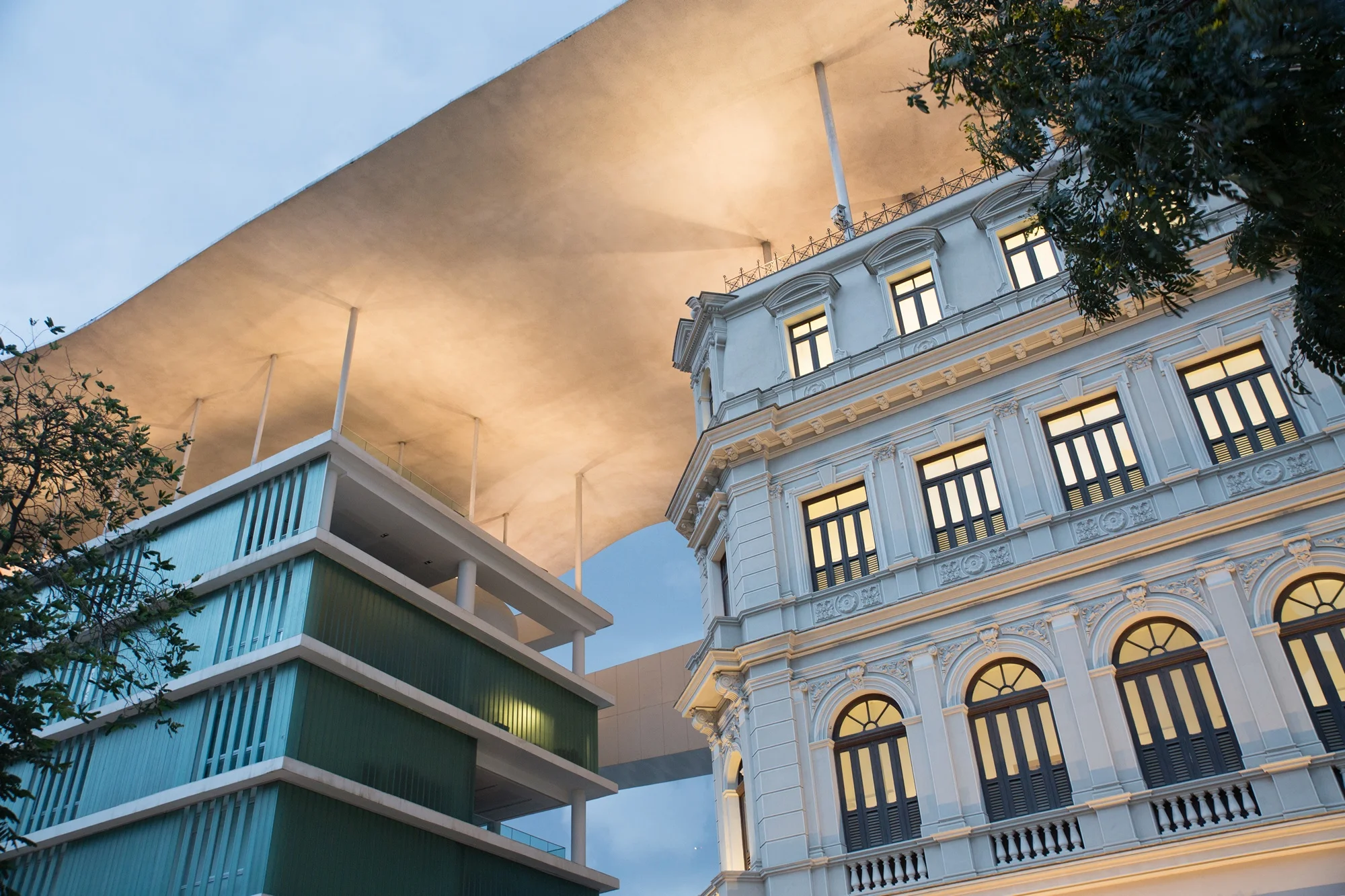
Rio Art Museum (MAR).
An interesting starting point is to observe the image and the expected funtion assumed by museums nowadays. The secularization of the western society seems to be connected with the ascension of the museums as they come to have reverenced and meaningful objects and the religions face a symbolic emptying, therefore part of the value atributed to museums comes from a transference of this deep human need, be it psychological or spiritual, which we want solved by a secular art.
The consequence of this art valorization is the elevated status assigned to museums today as holders of a invaluable cultural patrimony and the obscene pricing of these originals hanged in museums and houses and galleries of certain millionaires. Something so important creates a complicated situation for the visitors who want to get closer and actually understand the importance of art to our lives. Complicated because we revere the museum and the things in it, we treasure all those works and we learn that only a few illuminated people can create those incredible objects, but how can we understand Tarsila if we consider her to be so different and superior? How can we dive in Di Cavalcanti’s paintings if we considers ourselves unable to do it because the essential can only be seen by specialists? In the museums the only help comes from these almost catalographic texts explaining the collection the small plates telling us about dates, artist and material.
At the museum, facing the vibrant colors of the huge cannibal I couldn’t care less about year, ink and owner. I see a huge and absurd creature in a simple, almost schematic, environment, with colors I know familiar to my daily life, but also familiar to everything official and canon about Brazil. And what can I do with it if in the room there’s a line to take selfies with the painting, if there’s a bulletproof glass between me and the painting and the lights of the gallery prevents me from seeing the canvas? I wait until they stop taking selfies and leave, but there’s no seat or something like that also, because apparently they didn’t think any viewer may need more time and confort to do a deeper evaluation of the painting.
MAR isn’t a problem, it isn’t about crucifying an individual museum when in reality it’s a pattern. The exhibitions are risking being only this, art showcases, where the most intelligent visitor is the one photographing the small plates, so later he can research about it and find a digital version to analyse, interpet and really bring it to his life and mind routines.
To talk about art
Before going ahead I have to make it clear that I recognize many functions exercised by museums beyond this one I’m discussing. I understand that the museum is also an institution responsible by reasearch, restoration and many other essential cultural and academic activities which by themselves justify the existence of dedicated entities. But if I’m dealing only with the contact of the visitor with the collection it isn’t due to unawareness or to attack a weak spot, it’s because I want to discuss the layman experience and not the museum as a whole. I understand It’s impossible to think the museum without these other aspects, but I’m leaving them to another opportunity.
This “experience” I’m talking about isn’t necessarily attached to any academic limitation. I consider it openly knowing there’s a multiplicity of manners through which we can relate to art, therefore I’m thinking about how to make it possible, independent of the form. I believe this contact happens when art becomes revelant in someone’s life.
An example of this situation is when we feel sad and listen to depressing music which in principle would only deepen the problem, but in reality it help us, through a momento of introspection, to elaborate that feeling because they guide us and work as a meditative framework for the mind. We understand music because in shows we’re allowed to dance, sing, drink and use drugs, there’s no pomposity or reverence before music, we listen it a tour homes and in the bus. It’s true that it may prevent us from completely enjoying it at all times, but we must admit it’s constant presence and familiarity is better than an overly serious approach.
Complexities, obstacles and a light at the end?
The museum, like a cathedral,should prioritize the personal experience and the relationship with the artworks before attempting to become a touristic icon. An example of how to do this is the Rothko Chapel, located in Houston, built with the painter to be a contemplative space now displaying 14 of his black paintings. In the chapel Rothko’s paintings work as tools to create a space able to guide reflection and the visitor’s introspection. The investment to create something more elaborate isn’t necessarily a problem, or shouldn’t be, if we consider that only the Abaporu’s insurance costed almost 300 thousands dollars, according to Jones Bergamin, presidente-director of the Rio Art Stock Exchange.
We still have to discover if museums really are capable of making this change since everything is result of a complex conjuncture raging from economic, cultural and political questions. With na international art market breaking records at auctions, a government using art as a spectacle and the lack of mass art education, it’s no surprise that museums struggle being in the middle of the crossed fire, in one side our huge expectations and in ther other the limitating environment they’re submerged.
While these questions remains open, we must occupy the spaces offering some valuable experiences despite the obstacles. To see art not as something to consume but as something alive we need to get hold of so it don’t become only a museum piece, disponible for selfies. In all it’s weirdness the Abaporu still have a tremendous intensity, of roots, of a growing towards the earth and a serenity profound even for such a powerful figure. If there’s something Tarsila do Amaral taught us is how we are able alone and there’s greatnesse even in the smaller things. It doesn’t matter what’s expected from us, we can always create if we’re brave enough to try,